
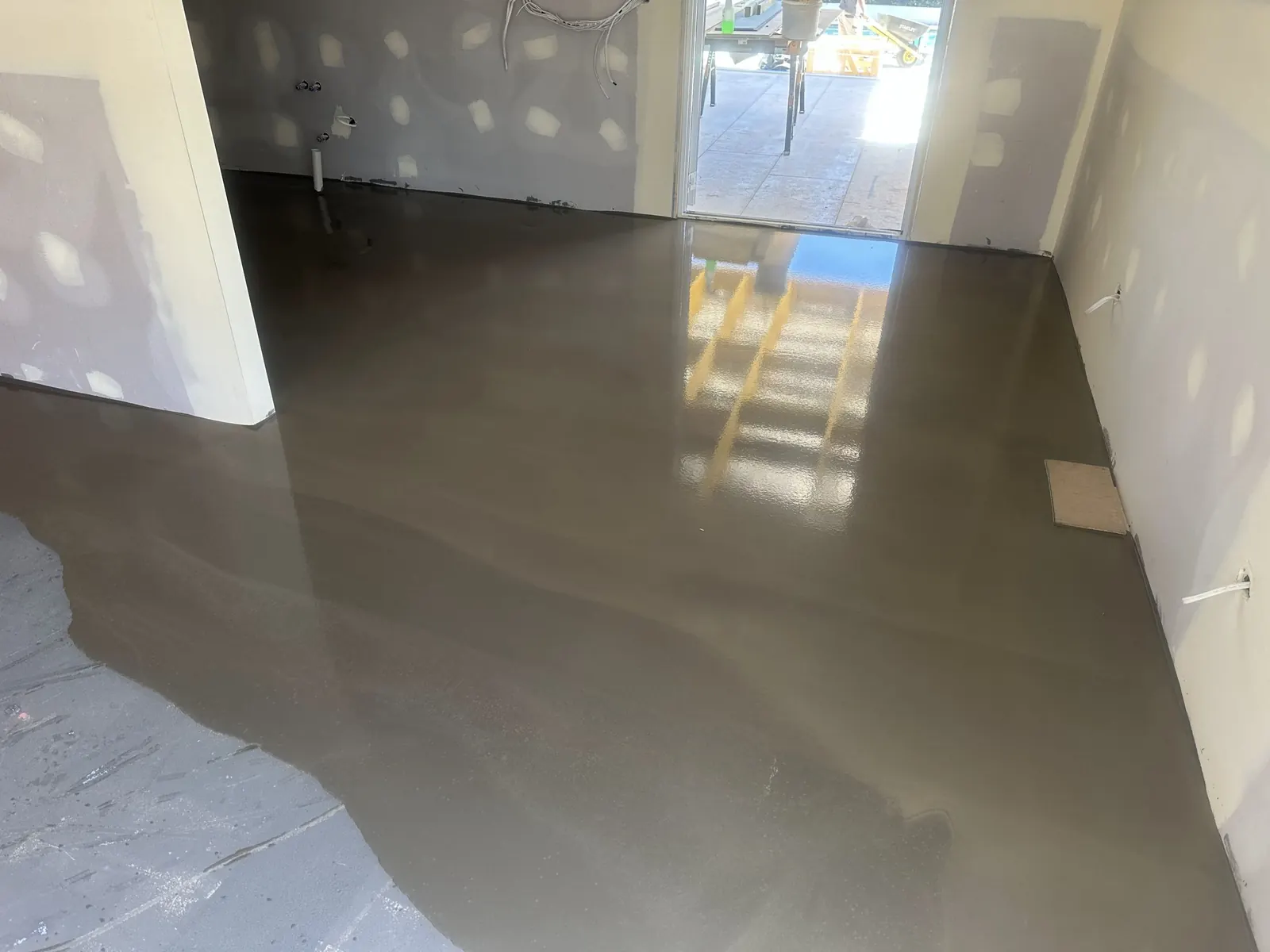
People use "level" and "flat" as if they mean the same thing. On a floor job they do not, and the difference decides whether your new floor stays quiet and tight or starts to separate.
Two different questions
Level asks whether the floor sits on one horizontal plane across the room. A floor can be a little out of level and still feel fine underfoot.
Flat asks whether the surface has dips and humps over short distances. A floor can be perfectly level end to end and still have a hollow in the middle of it.
Your flooring manufacturer cares about flatness. That is the tolerance written into the installation instructions and the warranty.
Why a hollow matters
Click-together floors, hybrid and floating engineered boards especially, rely on the joints staying locked. When a floor sits over a hollow, those joints flex every time someone walks across it. Click joints flexing over a hollow eventually separate. That is the part you cannot see on day one.
Hybrid is the right call for kids, pets, busy kitchens and tradie boots. It is also the floor most likely to fail on a poor substrate, which is why we check flatness against the manufacturer's tolerance before a plank goes down.
Herringbone and chevron are no different. Every block is cut and set to a line, so the set-out matters as much as the product, and so does the floor under it.
How we check it
At the site inspection I measure and check flatness, and I compare it with what the manufacturer requires for the product you have chosen. Where the slab is out, the fix is part of the written scope:
- Grinding opens the surface to a sound bond. It is dust-extracted, so your house stays livable.
- Levelling is laser-checked and self-levelled to the tolerance the manufacturer's warranty requires.
- Cracks and joints are classified and treated first, because a crack in the slab telegraphs through the finish if it is not.
Why this belongs in the quote
If levelling is needed, it should be written into the scope and priced once. If it is not mentioned, either the floor is already flat enough or nobody has checked. Ask which.
The point of all this is simple. The finish is the part you see. Preparation decides whether it still looks right in ten years.
What to do next
If you are comparing quotes, ask each contractor how they will check flatness and what tolerance they are working to. A straight answer tells you a lot.
Book the site inspection and I will check your floor against the manufacturer's tolerance and tell you what, if anything, it needs before the new floor goes down.